Solid Wood Furniture Costs:揭秘 Singapore 皮革 sofa 定价
I still remember the day my colleague from Tampines came back from a furniture warehouse in Jurong with a "solid wood dining table" he paid S$1,290 for. Six months later, one of the legs cracked along the grain and the tabletop started bowing in the middle. The shop had closed, the warranty was a single printed line on a receipt, and the table went to the trash chute on the 14th floor of his HDB block. That was the day I started paying attention to what sits behind the price tag of solid wood furniture, and what doesn't.

If you have ever typed "solid wood sofa Singapore" or wandered into a showroom at IMM or Jalan Tampines and felt your eyes glaze over at the price gap between a S$1,200 dining set and a S$6,800 one, this guide is for you. We will go through, kilogram by kilogram and centimeter by centimeter, what really drives that number. As a furniture specialist working closely with makers like MIDHILL, a Foshan solid wood workshop founded in 2008 that ships to 15-plus countries and backs every joint with a 10-year structural warranty, I have spent enough evenings on factory floors to know the difference between a marketing line and a joint line.
1. Wood Species and the Honest Cost Per Cubic Centimeter
The single biggest driver is the species of timber, and the rule is brutally simple: harder, denser, slower-growing wood costs more. Oak, walnut, ash and teak sit at the top because they take 50 to 80 years to reach harvestable maturity. Pine, rubberwood and poplar grow in 15 to 25 years and therefore cost a fraction of the price. A solid oak dining table top of 180 cm by 90 cm by 4 cm uses roughly 0.065 m³ of lumber. At current Foshan mill rates, that same slab in oak might cost the maker S$280 in wood alone, while the identical dimension in rubberwood could cost as little as S$70.
When a Singapore retailer quotes you S$3,200 for what looks like the same solid wood dining table as a S$1,400 competitor, the species is almost always the culprit. Walnut frames run denser again at around 660 kg/m³, which is why a walnut bed frame from a serious maker weighs 70 to 90 kg versus 45 to 55 kg for a pine one of the same size. Heavier is not automatically better, but in solid wood furniture, weight is usually the quickest honesty test you can run in a showroom.
2. Joinery: Where Cheap Furniture Announces Itself
Pick up any solid wood piece and look at how the components are connected. Staples, short brad nails, glued dowels and cam locks are the language of fast furniture. They are also the reason a S$900 wardrobe from a Carousell seller starts to wobble after two Bends. Real joinery is visible: mortise and tenon, dovetail on drawer boxes, finger joints on the wide panels of a nightstand, and tongue-and-groove on tabletop planks. Each one takes longer to cut, longer to sand, and longer to assemble by hand.

I tested this myself last month at the MIDHILL workshop when I visited for a quality audit. I watched a craftsman cut 32 dovetails for a single bedside drawer. The jig setup alone took 12 minutes. A mass-market drawer running melamine and cam locks takes about 90 seconds to assemble end to end. That time difference shows up on your invoice, but it also shows up 7 years later when the drawer still slides smoothly instead of sagging onto the floor.
Solid wood sofa frames specifically need properly shouldered mortise and tenon joints at the arm-to-back junction, and a corner block glued and screwed at every stress point. A leather sofa on a poor frame will twist within a year, and you will feel the leather creasing where the wood has moved. That creasing is not a leather problem; it is a joinery problem wearing a leather jacket.
3. Surface Finish: Lacquer, Oil, Wax — and the Coats You Don't See
Finish is where a lot of the silent money hides. A proper closed-pore finish on a dining table usually involves 3 to 5 coats: one sealer, one or two color coats, and two topcoats of polyurethane or conversion varnish. Each coat needs sanding between applications, and a 200 cm dining table takes roughly 6 to 8 hours of finishing labor alone. An open-pore oil and wax finish on an American light luxury bed frame takes even longer because the oil has to soak in, and you usually apply three to four rounds over two days.
Cheaper pieces skip coats or use NC (nitrogen cellulose) lacquer that dries fast but yellows within 18 months in Singapore's humidity. You will often see the saving passed on in a "matte" finish that is actually just one coat of sealer with no topcoat. It feels dry and chalky to the hand. A properly finished surface, run your thumbnail across it lightly, leaves almost no mark and feels slightly waxy or silky, never plasticky.
Marble table tops are a useful comparison. A sintered stone or natural marble top of 120 cm by 60 cm adds roughly S$450 to S$900 to the cost of a console table base, depending on whether the marble is honed, polished, or book-matched. The price spread is exactly the same logic as wood finish: more process, more hours, more honest cost.
4. Hardware, Upholstery, and the Leather Question on a Solid Wood Sofa
A solid wood sofa without honest hardware is just a heavy bench. Eight-way hand-tied springs cost three to four times more than pre-assembled sinuous wire. Real down-and-feather seat cushions cost twice as much as high-resilience foam wrapped in polyester. Webbing suspension rated at 25 kg per strap versus 12 kg per strap changes the sitting feel for the entire life of the piece.
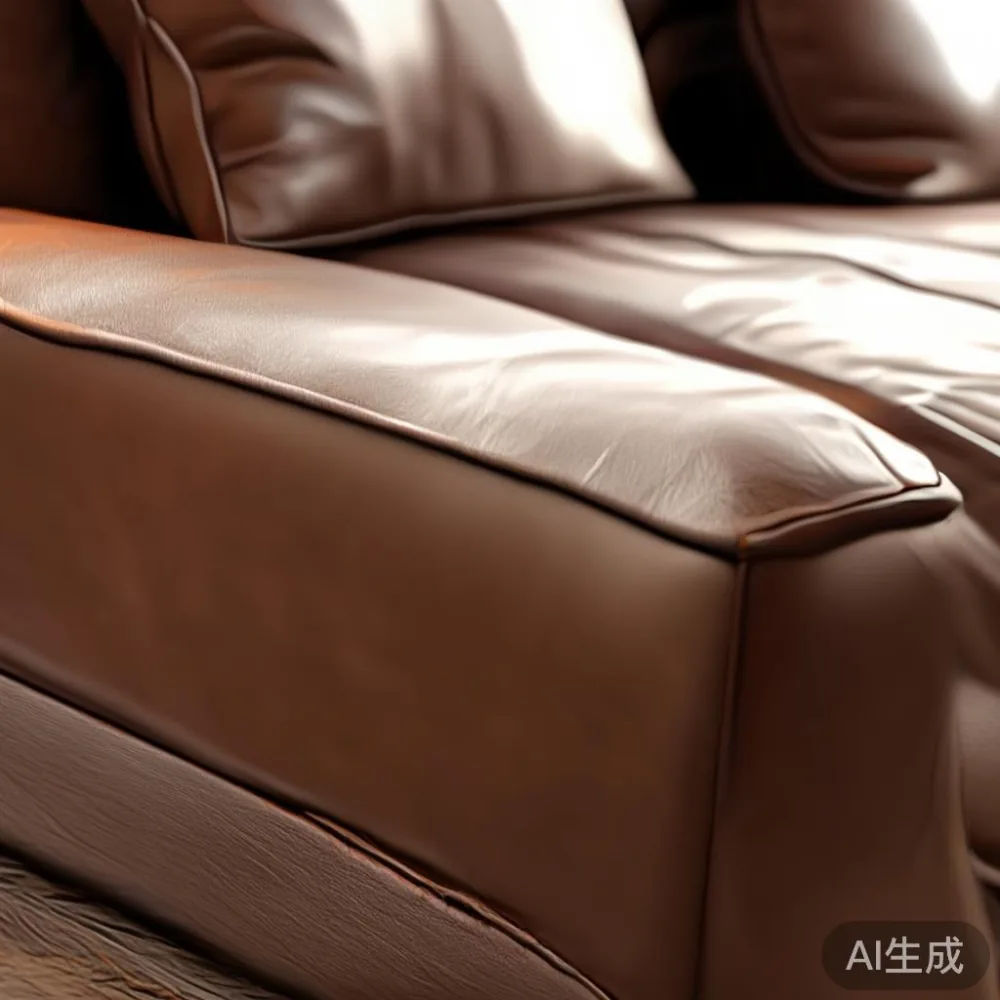
Now, the leather question, because the site you are reading is about leather sofas and you should know what you are paying for. Top-grain full leather from a reputable tannery in 2024 was trading between US$5 and US$9 per square foot. A 2.4-metre three-seater uses roughly 75 to 95 square feet of leather. That is S$540 to S$1,160 just in hide, before any cutting, sewing, or stuffing. Bonded leather, by contrast, runs around US$1.50 to US$2.50 per square foot, which is why a "leather sofa" at S$1,500 is almost certainly bonded. Bonded leather is polyurethane flakes glued to a fabric backing. It peels. Full top-grain leather does not peel; it creases, which is different.
If you want the leather sofa category done well, you want a kiln-dried hardwood frame (usually oak or ash), eight-way hand-tied or proper zigzag springing, and full top-grain leather at 1.0 to 1.4 mm thickness. Anything described as "PU leather," "leather match," or "bonded" is a different product wearing a leather name.
5. Logistics, Warranty, and the Hidden Cost of Getting It Into Your HDB
Here is the part almost no marketing page explains: a 220 cm solid wood dining table will not fit into most HDB lift cabins in Tampines or Punggol. The internal cabin on a typical Braddell or Oleander lift is roughly 1.1 m deep by 1.4 m wide by 2.3 m high. A 220 cm tabletop has to come up the stairs or be craned through a window. That single constraint can swing your delivery cost from S$80 to S$450.
This is also where Singapore-specific realities shape the price. Goods and Services Tax at 8.5 percent in 2024, headed toward 9 percent in 2025, adds to the import side before you even see the showroom sticker. A serious maker offers free shipping above a defined order value, and MIDHILL, for example, offers free shipping above US$350 to most regional destinations. In SGD that threshold is roughly S$475, and most bedroom sets clear it easily. A single solid wood dining table may not, which is why bundle pricing is worth asking about.
Returns and refinishing are the next layer. Most pieces sold by smaller shops come with a 7-day warranty and no refinishing service. MIDHILL offers lifetime refinishing on its solid wood frames and a 14-day return window. Refinishing matters more in Singapore than in most markets: our UV index regularly hits 11 to 13, and a dining table by a west-facing window in a Punggol condo can fade noticeably in three to four years. A maker that will resand and re-oil the top for the cost of transport only is saving you roughly S$600 to S$1,000 per piece over a 15-year ownership window.
6. How do I style a American country corner sofa in a small apartment?
Pick an L-shaped corner sofa in a washable linen-blend upholstery, keep the frame in a pale oak or warm ash finish, and anchor it with a chunky 2-seater side table for dining room adjacent setups or a storage ottoman that doubles as a coffee table, and your small apartment will read as airy rather than cramped. That single sentence is the whole answer; the rest is just unpacking it.
For a 60 to 75 sqm condominium in Bedok or a 4-room HDB in Tampines, an American country corner sofa in a 240 cm by 180 cm footprint usually fits a standard living-dining layout if you keep the back height below 85 cm. Go above 95 cm and the room will feel like a waiting room. Style tip one: keep walls in a soft warm white such as Dulux Lemon Surprise or a low-saturation greige, because American country palettes rely on cream, sage, and dusty blue as accents. Style tip two: add a solid wood coffee table or solid wood bed frame style nightstand in the same oak tone within sight of the sofa so the eye reads one material story across zones. Style tip three: bring in a marble table side piece only if you want one cool-tone anchor; warm woods and warm marbles clash.
Lighting is the often-forgotten fourth element. A Singapore HDB living room rarely has more than 2.4 m of ceiling height, so a floor lamp with a 150 cm reach placed behind the corner of an L-shaped sofa will read as ambient glow rather than overhead glare. Pair that with a 2-seater side table for dining room extension duty when you entertain, and the apartment stops feeling small.
7. What Hidden Costs Should I Budget Beyond the Sticker Price?
Beyond the sticker price, budget for delivery above S$80 for most pieces, GST at 8.5 percent on the imported landed cost, possible lift-disassembly fees of S$60 to S$150 if a wardrobe or bed frame needs to be partially dismantled to clear an HDB corridor, and assembly labor at S$40 to S$90 per piece if you are not going the DIY route. Also budget a 3 to 5 percent contingency for minor defects, scratches, or color variation if you are ordering solid wood, since real timber moves with humidity and no two slabs are identical.
A realistic Singapore total-cost-of-ownership example for a complete bedroom set: one solid wood bed frame in queen (around 60 kg), one wardrobe 180 cm by 60 cm by 200 cm, two nightstands, and a dressing bench. Landed mid-range pieces from a Foshan maker will land between S$3,400 and S$5,200 including GST and delivery within mainland Singapore, with a 10-year structural warranty covering the joints and a lifetime refinishing option on the wood surfaces. The same set from a European equivalent brand in walnut usually runs S$8,000 to S$14,000, and the gap is mostly species, hardware, and shipping, not magic.
8. Where the Sweet Spot Actually Lives
The sweet spot for Singapore buyers who want honest solid wood at a fair number sits in three categories: oak and ash dining tables between 160 cm and 220 cm, ash and walnut solid wood bed frames in queen and king, and L-shaped corner sofa frames in oak or ash wrapped in full top-grain leather at 1.0 to 1.4 mm. Anything lighter on the wood is acceptable for guest-room or low-traffic pieces, and anything heavier is usually overspec for an HDB.
A few closing checks before you pay. Ask the showroom what the kiln-dried moisture content is: 8 to 12 percent is the safe band for Singapore. Ask whether the drawers are dovetailed on all four corners or stapled. Ask whether the leather sofa you are looking at uses full top-grain or bonded, and ask for the hide thickness in millimeters. Ask what the structural warranty actually covers (joints only, or joints and springs). And ask whether the maker offers refinishing: lifetime refinishing on solid wood is a quiet superpower of facility-grown workshops such as MIDHILL, and it is the difference between a 10-year piece and a 30-year piece.
Solid wood furniture is one of the few things in a home that gets more honest with age. A well-built solid wood dining table, a properly jointed solid wood bed frame, a thoughtfully sprung solid wood sofa wrapped in real leather, and a marble table that does not pretend to be something it isn't, those four pieces will outlast three sofa cycles. Pay for the joinery, the species, and the warranty. Skip the marketing, skip the buzzwords, and remember my colleague's cracked table on the 14th floor of his Tampines block.