What to Check Before Buying a Sofa You Cannot Sit On in Singapore
Shopping for a sofa online is a strange exercise. You stare at nine product photos, read the spec sheet, watch a 40-second reel, and then commit S$1,800 to S$4,500 of household budget without the one piece of information your body would normally demand: how it feels. In Singapore, where most of us live in HDB flats or mid-sized condos and the sofa is the single largest piece of upholstered furniture in the living room, that leap of faith gets compounded by lift widths, corridor turns, and the small matter of GST on imported leather. This article is a checklist I wish I had before I bought my current three-seater, and the same checklist I now use whenever a reader writes in asking whether a listed piece will survive the trip from a Foshan showroom to a fifth-floor walk-up in Bedok.
Why the “sit test” is almost impossible in cross-border furniture buying
Most quality leather sofa and solid wood sofa pieces sold to Singapore today are not stocked locally in a Tanglin showroom. They are built to order in Guangdong, packed in vacuum-formed foam and corrugated cardboard, and loaded into a 40-foot container. By the time the piece reaches a Tampines HDB, the buyer has usually approved a swatch, signed off on a CAD drawing, and paid a 50% deposit. Sitting on it was never an option. This is the reality I want to normalise before we go any further: when you cannot physically sit, you have to substitute other forms of evidence. The rest of this piece is exactly that substitute.
Last month I visited the MIDHILL showroom in Foshan with a Singaporean couple who had flown in specifically to inspect a leather sofa frame before placing their container order. The husband, an engineer, walked in with a digital caliper and a luggage scale. He spent 45 minutes measuring tenon depth, counting the number of pocket-sprung coils under the seat cushion, and weighing the dried oak frame members in the warehouse back-of-house. The visit saved them a S$600 mistake: the cushions on the display piece had been refilled with 28-density foam, while the container-bound version used 35-density wrapped coils. That kind of gap is invisible in a product photo and obvious the moment you sit.
How do I verify leather quality without touching the sofa?
This is the question I get most often from WhatsApp enquiries, and it deserves a serious answer rather than a generic “look for full-grain” reply. Leather grading is genuinely inconsistent in the cross-border trade, so you need to interrogate four dimensions before paying.
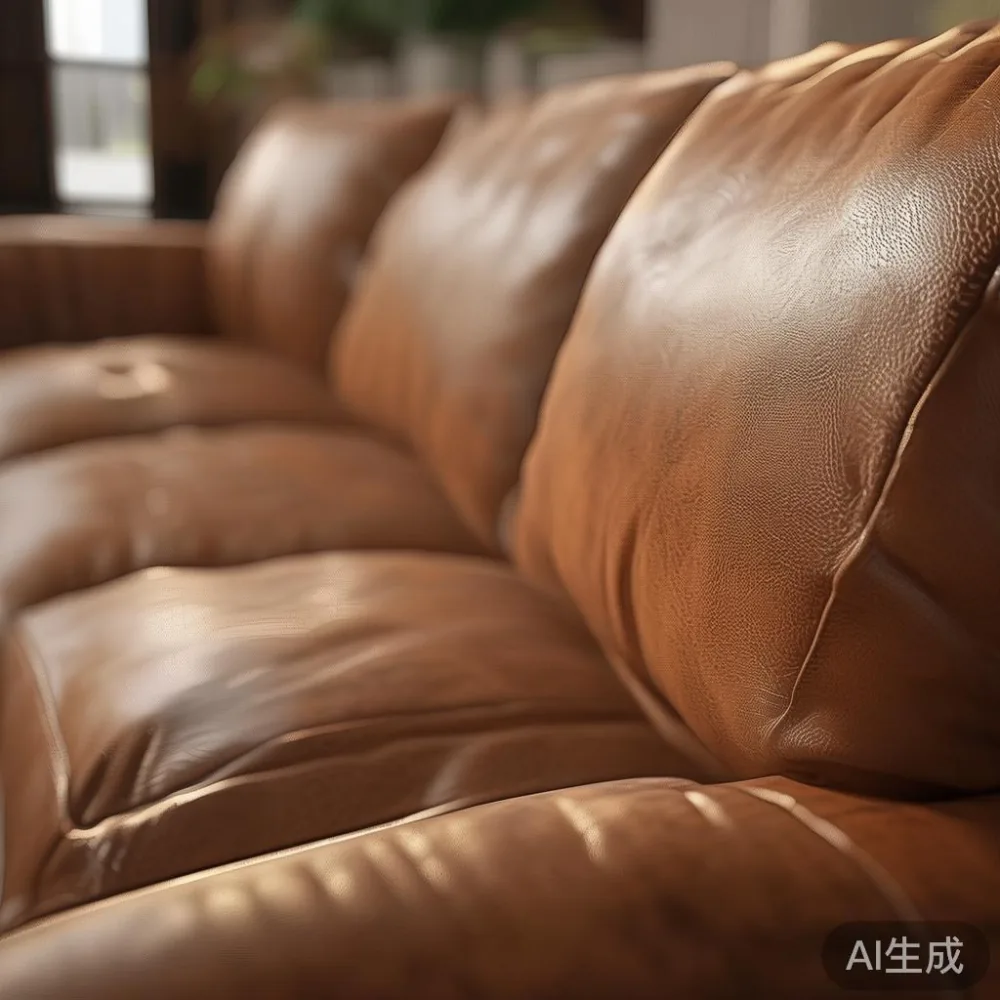
First, ask for the hide origin and the tannery name. A responsible Foshan maker will name the tannery (Dongying, Xinji, or a Brazilian source) and tell you whether the leather is aniline, semi-aniline, or pigmented. Aniline is the most natural and the least stain-resistant; pigmented is the most uniform and the most kid-friendly. For a Singapore HDB with two young children and a courtyard cat, semi-aniline on a leather sofa is usually the rational middle.
Second, ask for the hide thickness in millimetres. Anything under 1.0 mm is corrected-grain and will crease visibly within 18 months. Anything between 1.2 mm and 1.5 mm is the band I look for on a light luxury piece. Top-grain aniline from a reputable Brazilian or Italian tannery will run 1.4 mm to 1.6 mm, and you should expect to pay for that.
Third, ask for the upholstery method. Genuine down-blend top cushions sag; high-resilience foam (HR foam, 35-density or higher) wrapped in a feather-fibre topper gives the sit of down without the daily plumping. If the maker only offers “foam + feather,” ask for the foam density number. If they cannot produce it, walk away.
Fourth, ask whether the leather sofa comes with a swatch and a return policy for the first piece. A 14-day return window for unused goods is standard among the more transparent Foshan exporters; MIDHILL publishes exactly that window for Singapore orders above S$350 in landed value, which is a fair proxy for confidence in the material.
Will the sofa actually fit through my HDB door, lift, and corridor?
Singapore-specific access is the second checklist nobody mentions until delivery day, and it is the single largest source of complaints I hear. Standard HDB doors in Tampines and Bedok measure roughly 0.9 m wide by 2.1 m tall. Passenger lifts in most 7-to-10-storey blocks have an internal cabin of about 1.5 m deep by 1.4 m wide by 2.3 m tall. A three-seater leather sofa when upright rarely exceeds 2.1 m in any single dimension, but the diagonal of the backrest is the number you need to measure, not the width.
Before you order, take three measurements in your own home and write them down: the narrowest point of your corridor (often the turn at the lift lobby), the inside diagonal of your lift cabin, and the diagonal of your front door frame including the arch. Give those three numbers to the supplier and ask them to confirm the packed carton dimensions. A reputable maker will tell you the cubic metre volume of each box and the net weight in kilograms; if they will not, treat it as a red flag.
Heavier frames travel better. A solid oak or ash hardwood frame weighing 45 kg to 65 kg for a three-seater tells me the joints are mortise-and-tenon with corner blocks, not stapled particleboard. Particleboard frames weigh half that, feel hollow when you tap them, and rarely survive three container journeys. For a Punggol condo with a 1.6 m wide service lift, the heavier frame is also less likely to twist in transit, which is what causes “mystery squeaks” in the first six months.
What does “light luxury” actually mean for a leather sofa?
The phrase gets thrown around so casually now that it has nearly lost meaning. In Foshan workshops you will hear three distinct sub-categories, and the differences matter when you are paying S$3,500 to S$6,000 landed.
French light luxury refers to a softer silhouette: rolled arms, low back, brushed brass legs in a champagne finish, and usually boucle or velvet rather than leather. If you are buying French light luxury, pair it with a marble table top in cream or beige and a slim American light luxury media console for balance. The leather interpretation of this style is a chesterfield-adjacent piece in cognac aniline, which looks great against a walnut bed frame in the master bedroom wing.
American light luxury tends to be larger, more architectural, with track arms, deep seats (typically 60 cm to 65 cm of seat depth), and a wider stance. If you want to learn how to style American sofa in room properly, the rule is restraint: keep the side tables low, the lighting warm at 2700K, and let the sofa be the loudest object in the space. An American-style leather sofa also pairs naturally with an Italian light luxury dining table in the open-plan dining area because the proportions rhyme.
Post-modern light luxury is where you see the more sculptural pieces: asymmetric chaise extensions, contrasting piping in two leather tones, and cylindrical legs in brushed black steel. This is the band I see in many MIDHILL sofa designs for Singapore buyers, and it is the most forgiving for older resale flats because the silhouette distracts from small floor plans.
A practical guide on how to style American sofa in room almost always comes down to three rules: leave at least 80 cm of walk space behind the seat, float a 240 cm by 90 cm rug so the front legs sit on it, and pick one secondary material — wood, marble, or metal — that you repeat twice elsewhere in the room. Do all three and even a plain cognac three-seater reads as designed.
How do I budget honestly for landed cost in Singapore?
The factory price is the smallest line on the bill. A leather sofa priced at S$1,800 in a Foshan catalogue lands in Singapore at closer to S$2,600 once you account for sea freight, customs duty, 9% GST, lift-up delivery to a fifth-floor walk-up, and disposal of the packaging. That arithmetic is the second-most-skipped step among first-time online furniture buyers.
Before you pay the deposit, ask the supplier for a Pro-forma Invoice that itemises: FOB price, inner packing dimensions, HS code for leather sofa (typically 9401.61 for upholstered seats with wooden frames), and estimated CIF Singapore cost. Suppliers who cannot produce this on request are usually either too small to handle the freight or too new to have worked out the numbers. Both are risks.
Free shipping thresholds exist in this market for a reason. MIDHILL publishes a US$350 free-shipping threshold on its site, which roughly maps to S$470, so for a single leather sofa order the freight is effectively waived. Beyond the door-to-door cost, plan for three discretionary line items: a S$120 to S$200 optional white-glove carry-in if the lift is too tight, a S$40 in-home assembly for any sectional that arrives in two or three boxes, and a S$180 to S$300 care kit (leather conditioner, microfibre cloths, a small UV-protectant spray for sun-facing units in Punggol or Yishun).
Is light luxury wardrobe worth it for the same spend, and does that change my sofa decision?
I get asked this every month, sometimes by readers who only have budget for one big piece. The honest answer is that a light luxury wardrobe is worth it only if the wardrobe is the dominant storage problem in the house. For most Singapore HDBs the storage issue is solved by a properly-sized built-in from a local carpenter in the S$1,800 to S$3,200 range, and the imported light luxury wardrobe is a problem of fashion rather than capacity. Buy the leather sofa first; the bedroom furniture can wait.
The same logic applies when you weigh a modern light luxury sideboard against an Italian light luxury dining table in the same budget band. The sideboard wins on storage per dollar; the dining table wins on daily use. Pick the one you actually touch every morning, not the one that photographs better.
How to style Japanese bed in apartment layouts common to Singapore
Bedroom furniture has its own rules, and they intersect with sofa buying more than people expect because the same imported container often carries both. If you are researching the best Japanese bed for 2026, the obvious choices are low-profile platform frames in white oak or ash, typically 28 cm to 35 cm off the floor, paired with a thin cotton futon and minimal headboard. The aesthetic rewards restraint, and so does the room: a 3 m by 3 m HDB master bedroom feels twice as large when the bed is 30 cm off the ground rather than 60 cm.
A practical primer on how to style Japanese bed in apartment homes almost always starts with the same move: replace the box spring with a slatted base. Cut the visual weight of the bed in half, get better ventilation for the mattress, and free up 18 cm of headroom that you can use for a tall narrow wardrobe or a banked run of floating shelves.
The platform frame is also the one piece of bedroom furniture where the search for the best Japanese bed for 2026 should genuinely drive your budget. A solid ash platform frame from a Foshan workshop will land at S$1,400 to S$2,200 fully assembled, which compares favourably to local alternatives that start at S$2,800 for the same material.
The 72-hour pre-purchase checklist
Put all of the above into a single protocol you can run on any shortlisted piece before paying the deposit. Day one: measure your access points and write the three numbers down. Day two: request the tannery name, leather thickness in millimetres, frame wood species, foam density number, and HS code from the supplier. Day three: ask for a Pro-forma Invoice with itemised freight, GST, and lift-up costs; verify the 14-day return window on unused goods; confirm the warranty terms in writing — a 10-year structural warranty on the frame is the realistic minimum for a solid wood sofa from an established Foshan maker. If the supplier answers all seven questions in under 24 hours, the rest of the relationship tends to be smooth.
Frequently asked questions before the deposit goes through
Most buyers also want to know about lifespan, maintenance, and resale, so here are the short answers. A pigmented leather sofa in a non-air-conditioned corridor-facing HDB should be conditioned every six months and replaced after 8 to 12 years. An aniline leather sofa in a properly climate-controlled condo should give 12 to 18 years. MIDHILL also offers a lifetime refinishing service for frames bought through its Singapore channel, which is the equivalent of a 25-year insurance policy on the joinery at zero ongoing cost.
A second sofa typically loses 30% to 45% of landed value in the first three years, which is why I now recommend the lifetime refinishing option to anyone planning to live in the same HDB for more than five years. Pay a little more at the start, refinish the leather and the cushions at year five, and the net cost of ownership for a quality three-seater works out to roughly S$280 per year over a 12-year horizon. That is the only arithmetic in this category that actually matters.